Pages

Wednesday, August 15, 2012

The Mongolian Nobility

The Mongolian Nobility

The Mongolian nobility (Mongolian: язгууртан yazgurtan; Mongolian: сурвалжтан survaljtan) arose in the 10-12th century, became prominent in the 13th century, and essentially governed Mongolia until the 20th century.
The Mongolian word for nobility, Yazgurtan, derives from the Mongol word yazgur, meaning the Root.

Contents


Mongol Empire

Nobility titles

  • Ihe Khaan (Khagan) - Great Khaan, Emperor
  • Guo Wang - State Wang, the second title after the Great Khaan. Muhulai (Muqali) of Jalair was appointed the Guo Wang.
  • Jinong - Prince Royal, nominated to succeed the Great Khaan. During Yuan Dynasty, the Jinong resided in Karakorum and administered Mongolia Proper
  • Taiji - Prince
A Mongol ruler on his way through the country. Illustration of Rashid al-Din's Jami' al-tawarikh.

Military ranks

  • Tumetu-iin Noyan - Lord of 10,000 warriors. There were 9 Tumens in 1206. By 1368 there were 40 Mongol Tumens and 4 Oirat Tumens
  • Minggan-u Noyan - Lord of 1,000 warriors
  • Jagutu-iin Darga - Commander of 100 warriors
  • Arban-u Darga - Commander of 10 warriors
  • Cherbi - Head of the Kheshig

Female titles

  • Hatun - queen and ladies
  • Gongju - princess, daughter of a noble family
  • Behi - lady

Post-Imperial Mongolia

Nobility titles

  • Khaan (Khagan) - ruler of the country.
  • Khan - by the mid-16th century, there would be a number of khans in Mongolia as local feudal lords claimed the title for themselves. Khaan and Khan were 2 different titles: Khaan (long "a") and Khan (short "a"). Khaan was the title of the ruler of the country, while the local feudal lords had the title Khan.
  • Jinong - Prince Royal, nominated to succeed the Great Khaan. Resided in the Right Wings (modern Inner Mongolia). From the 15th century, the title became hereditary and not necessarily preserved to the nominee of the Khaan's heir
  • Hongtaiji - a descendant of Genghis Khaan with a fief or a prince (Huang Taizi)
  • Taiji - a descendant of Genghis Khaan or a prince
  • Wang - a descendant of Khasar and other brothers of Genghis Khaan with a fief
  • Taishi - a noble of a non-Borjigin clan with a fief such as descendants of the Tumetu-iin Noyans or a non-Borjigin chieftain

Female titles

  • Hatun - queen and ladies
  • Gongju - princess, daughter of a noble family
  • Behichi (Beiji) - lady, spouse of a prince

Non-gentry estates

  • Sain humun - lit. good man, a rich person
  • Dund humun - lit. middle man
  • Magu humun - lit. bad man, a poor person
  • Hitad humun - lit. Chinese man, a slave

Manchu period and Boghda Khaan Mongolia

A Khalkha Mongolian noblewoman (c.1908).

Nobility titles

  • Khan (not Khaan or Khagan) - Lord of a hoshun. There were 4 Khans in Khalha: Tushietu Khan, Zasagtu Khan, Secen Khan and Sain Noyan Khan, and 2 Khans in Kobdo Region: Tögs Hülüg Dalai Khan and Ünen Zorigtu Khan. They were khan rather than khaan. Despite the association of the 4 aimags with these titles, their power was restricted to their hoshuns only. They would communicate with the Manchu court just as any other Lord of a hoshun.
  • Chin Wang - Lord of a hoshun. Some Wangs were ranked as Hoshoi Chin Wang - "Chin Wang twice". Annual income 2500 lang silver and 40 silk roll. 60 serfs.
  • Giyün Wang - Lord of a hoshun. Annual income 1200-2000 lang silver and 15-25 silk roll. 50 serfs.
  • Beile - Lord of a hoshun. Annual income 600 lang silver and 13 silk roll. 40 serfs.
  • Beise - Lord of a hoshun. Annual income 500 lang silver and 10 silk roll.
  • Tushiye Gong - Lord of a hoshun. Annual income 300 lang silver and 9 silk roll.
  • Tusalagchi Gong - Lord of a hoshun. Annual income 200 lang silver and 7 silk roll.
The above titles would be decorated with styles.
Infant Baatar wang in 1914.
  • Hohi Taiji - Untitled Gentry. There were 4 ranks:
Terigun Zereg-un Taiji - Gentry of the 1st rank could also be granted a hereditary lordship over a hoshun. Annual income 100 lang silver and 4 silk roll.
Ded Zereg-un Taiji - Gentry of the 2nd rank could also be granted a hereditary lordship over a hoshun. Annual income 90 lang silver and 3 silk roll.
Gutagaar Zereg-un Taiji - Gentry of the 3rd rank. Annual income ... lang silver and ... silk roll.
Dötugeer Zereg-un Taiji - Gentry of the 4th rank. Annual income 40 lang silver only. 4 serfs.
Besides the above ranking, the nobles were also divided into 2 types:
Töröl Taiji (literally, "related nobles") - members of 'Altan Urug', who are descendants of Genghis Khaan.
Khariyatu Taiji (literally, "subject nobles") - descendants of Khasar, Belgutei and other brothers of Genghis Khaan, descendants of Tooril Khan of Kereit, descendants of Tumetu-iin Noyans.
Age - son born to a noble family.
Tabunang - son-in-law of a noble family.

Non-gentry estates

  • Soumon Albatu - state serf
  • Hamjilga - serf of a nobleman
  • Shabi - serf of a Hutuhtu, of an incarnation of a Buddhist deity

MONGOLIAN LAND OF MAP

MONGOLIAN LAND OF MAP


Mongol: 28 Bonan baoan, 29 Bayad/Bayan, BU 30 Buryat, 31 Daur dagur, 32 Darchad, 33 Darigana, 34 Dongxiang, 35 Dörböd, MO/NM 36 Khalkh, KA 37 Kalmyk khalmag, 38 Khamnigan-mongqol, AF's north: moghol, 39 Tu monguor, 40 Ölöt yikh mianggan, 41 Ili-torgut, 42 Urjanchaj, 26 Soyot mator, 27 Yurat yurak,
57 Altai-Uryangkhai, 49 Solon, 50 Ongkor Solon, 51 Oroch nani/orochisal, 52 Orok, 43 Üzemkhin/Üzemcin.


Mongolia: what are the risks for an economy that's growing at 20 percent?

Mongolia: what are the risks for an economy that's growing at 20 percent?


There is good news coming out of Mongolia, the land of the eternal blue skies. The economy racked up a second quarter of high growth: the third quarter came in at 20.8 percent, topping the equally amazing second quarter of 17.3 percent (year-on-year GDP growth), as discussed in the World Bank's report.  And while this growth spurt originated in the mining sector, with Oyu Tolgoi—a mega copper and gold mine—getting ready to start producing in 2012 and a whole battery of other, smaller mines producing at full capacity, the high growth is quite broad-based. Even manufacturing is doing well.
There is more good news: unemployment is going down, and, if the pattern from the previous high growth episode applies, we think that poverty is also being reduced significantly.
However, there are some caveats to the good news. The global risks are mounting. Recall that Mongolia was one of the worst affected countries during the last crisis (2008/9), being a small, open economy, dependent on mining. Any mineral price shock immediately impacts the budget. And since Mongolia will have to borrow large amounts of money to put in place the infrastructure to get the minerals out of the ground and on to the market, rising emerging market bond yields are also not good news. Finally, China is Mongolia’s main export market, and if growth slows down there, it immediately affects Mongolia. Already, mineral prices are trending down.

Domestically, inflation came in at 11.9 percent in September, and 12.6 percent in October. If you take out food inflation, which has been volatile, core inflation has now consistently, and worryingly, risen throughout the year. This is one of the tell-tale signs of an economy which is overheating. Both the private as well as the public sectors seem to be trying to grow faster than the country’s capacity allows.
Further stoking inflation is the cash distribution to all Mongolian citizens. The government is handing out cash to its citizens to fulfill an escalation of political promises about the sharing of the mining wealth made by politicians in the run-up to the last elections in 2008. Senior politicians have now publicly and privately acknowledged that this is not to be repeated, as the transfers fuel inflation. However, there are general elections scheduled for next year. Better make good on the past promises first, say the politicians. After the elections we will stop the handouts. But time will tell.
Already the economic talk on Mongolia’s avalanche of TV stations is all about rising inflation and how it erodes the purchasing power of the middle class. And half of the informal sector workers we regularly survey as a barometer of how the poor are doing tell us that their current wages no longer cover their basic needs.
Fortunately, the 2012 Budget contains a targeted poverty benefit (being prepared with assistance of the ADB and the World Bank). This would put in place the type of social safety net to protect the poor from hardships—a net so sorely missed during the last crisis.
What are the policy-makers doing about the rising inflation? To contain inflation, the central bank and the government need to work in tandem to pull in the reins of Mongolia’s speeding economy.
The Bank of Mongolia has so far done a commendable job: it raised interest rates three times and banks’ reserve requirements twice, which made the governor rather unpopular in certain circles. But without these unpopular interventions, the inflation picture would have been a lot worse. And the Bank of Mongolia’s actions are clearly not enough, since core inflation has kept rising. So more tightening will be needed.
In the meantime, the government seems to be working in the other direction. The original 2011 Budget had already raised spending by 32 percent over the 2010 budget outturn. Then, the recently passed 2011 Budget Amendment added another 20 percent of public spending to this. Now, the 2012 Budget proposed by government and currently being debated in parliament would set an all time record for expenditure growth.
Without going into the details, the 2012 draft budget is based on very optimistic projections for GDP, revenues and expenditures. But will foreign direct investment continue its stellar rise? Will the mining sector continue to grow, even though logistical capacity constraints are already apparent? And can public investment really be raised this fast? Is this really possible? Economic observers are hoping that parliament can set election fever aside, reign in spending growth, and support more prudent fiscal management: the type of fiscal management as already defined by the Fiscal Stability Law of 2010.
The FSL is landmark legislation passed with overwhelming majority in parliament in 2010. It contains three fiscal rules to save windfall mining revenues, avoid over-borrowing and restrain over-spending. The World Bank assisted in creating the consensus around the fiscal rules contained in this law, which was also conditionality in the successfully concluded IMF Stand-By Arrangement. We shuttled as many as three delegations of parliamentarians and top civil servants around the world, including twice to Chile—a very well-managed copper producer.
Under the law, the application of the fiscal rules to the budget is phased in over time, with only one rule—the saving of windfall mining revenues into a stabilization fund— operational this year. However, since the economic growth is so widespread, this year’s “windfall” revenue growth is coming from many sources, not just mining revenues.
Our advice? With global risks continuing to grow, China’s growth slowing down, mineral prices down, and an economy which is overheating, it would be wise to start implementing the spirit of the fiscal rules now. Because one of the key lessons of recent times is that moderation needs to be applied during the good times, and not be postponed to another day. That day could bring clouds to Mongolia’s eternal blue skies.

Монголын 20 хувийн өсөлт бүхий эдийн засгийн эрсдэл нь юу вэ?


Мөнхийн хөх тэнгэртэй Монгол орноос чимэгтэй сайхан мэдээнүүд сонсогдож эхэллээ.  Энэ оны гуравдугаар улиралд эдийн засаг 20.8 хувь өсч, хоёрдугаар улиралын 17.3 хувийн өсөлтийг ч гүйцсэн нь урьд өмнө байгаагүй эдийн засгийн тэсрэлтийг бий болголоо ( өмнөх жилийн мөн үетэй харьцуулсан өсөлт). Энэ өсөлт нь уул уурхайн салбар, ялангуяа 2012 онд үйлдвэрлэлт нь эхлэх алт зэсний дэлхийн хэмжээний орд болох Оюу толгойгоос үүдэлтэй ч бусад олон жижиг уул уурхайнууд бүрэн хүчин чадлаараа ажиллаж байгаа учир хамрах хүрээ нь өргөн байна. Үйлдвэрлэлийн салбар ч сайн байна.
Бусад сайн мэдээнүүдийн хувьд, ажилгүйдлийн түвшин буурч байна. Нөгөөтэйгүүр энэхүү өсөлт үргэлжилбэл ядуурлын түвшин ч нилээд буурахаар байна.

Эдгээр сайн мэдээнүүдийн хажуугаар саар зүйлүүд бас гарч байна. Дэлхийн эдийн засаг эрсдэлтэй байна. Эргэн санахад хамгийн сүүлийн (2008/09) эдийн засгийн хямрал болоход Монгол Улс жижиг, уул уурхайн салбарт тулгуурласан мөн нээлттэй эдийн засагтай улсын хувьд хамгийн хүндээр нэрвэгдсэн орнуудын нэг болж байсан. Эрдэсийн түүхийн эдийн үнэ ихээхэн өөрчлөгдөхөд улсын төсөвт нь шууд нөлөөлдөг. Мөн эрдэсийн баялагаа олборлоход шаардлагатай байгууламжийг барих, олборлосон түүхий эдээ зах зээл дээр гаргахад ихээхэн хэмжээний зээл авах хэрэгтэй байгаа үед санхүүгийн зах зээл дээрх бондын хөрөнгө оруулалтын үнэ ихээхэн өсөж байгаа нь сайн мэдээ биш. Эцэст нь Монгол Улсын экспортын барааны гол хэрэглэгч нь Хятад улс. Хятадын өсөлт саарахад Монголд маш түргэн мэдрэгддэг. Эрдэсийн түүхийн эдийн үнэ бас буураад эхэлчихсэн байдаг.

Инфляцын төвшин 9 сард 11.9 хувь, 10 сарын байдлаар 12.6 хувь байна. Хэрвээ үнийн хувьд хэлбэлзэлтэй байгаа хүнсний бүтээгдэхүүний инфляцыг оруулахгүйгээр суурь инфляцыг авч үзвэл жилийн туршид сэтгэл зовоох хэмжээнд өсч байна. Энэ нь эдийн засаг хэт халж байгааг харуулж байна. Ер нь төрийн болоод хувийн хэвшлүүд улсынхаа эдийн засгийн шингээх чадавхиас илүүтэйгээр хурдтай байна. Мөн хүн бүрт олгож буй бэлэн мөнгө инфляцыг ихээхэн хөөрөгдөж байна. 2008 оны сонгуулиар улс төрийн гол намуудын уул уурхайн ашигаас иргэн бүрт хишиг хүртээнэ гэсэн амлалтыг биелүүлэх зорилгоор засгийн газар ард түмэндээ бэлэн мөнгө тарааж байна. Туршлагатай улс төрчид инфляцыг хөөрөгдөж буй бэлэн мөнгөний амлалт дахин давтагдахгүй гэдгийг өөртөө болон олон түмэнд зарлан хэлж байна. Гэсэн хэдий ч дараа жил сонгууль болно. Улс төрчид, урьдын амлалтаа эхлээд биелүүлэх нь чухал, тэгээд бид сонгуулийн дараа бэлэн мөнгө өгөхөө зогсооно гэж байна. Гэвч, цаг хугацаа бүхнийг харуулна.
Монголын телевизүүдээр инфляци өсч байгаа, дундаж орлоготой иргэдийн амьжиргаанд хэрхэн нөлөөлж байгаа талаар мэдээ, ярилцлагууд өргөнөөр гарч байна.  Бага орлоготой хүмүүсийн амьжиргааг тодорхойлохын тулд бид албан бус ажиллагсадын дунд судалгаа тогтмол хийдэг. Сүүлийн судалгаанаас үзэхэд эдгээр хүмүүсийн олж буй орлого нь тэдний суурь хэрэгцээг нь хангахааргүй хэмжээнд болсон байна.
Харин 2012 оны төсөвт ядууст чиглэсэн халамжийн хөтөлбөрийг (Дэлхийн Банк болон Азийн Хөгжлийн Банкны туслалцаатай боловсруулсан) суулгаж өгсөн нь сайшаалтай.  Ийм халамжийн багц нь хэцүү үед ядуу, орлого багатай иргэдийг хамгаалж , амьжиргааг нь дэмжихэд ихээхэн ач холбогдолтой. Ийм хөтөлбөр эдийн засгийн өмнөх хямралын үед огт байгаагүй болно.
Бодлого боловсруулагчид өсч буй инфляцийн талаар ямар арга хэмжээ авч байна вэ? Хэт хурдацтай өсч буй Монголын эдийн засгийн жолоог татахын тулд Засгийн Газар, Монгол Банк хоорондоо харилцан уялдаатай ажиллах хэрэгтэй.
Монгол Банкны зүгээс энэ жилд мөнгөний бодлогын хүүг 3 удаа нэмж, нөөцийн хэмжээг 2 удаа шинэчилсэн нь зөв бодлого. Харин энэ алхамууд нь төв банкны ерөнхийлөгчийн нэр хүндийг тодорхой хүрээнд унахад нөлөөлсөн.   Гэхдээ эдгээр хязгаарлалтуудыг авч хэрэгжүүлээгүй бол инфляциин түвшин илүү өндөр байх байлаа.  Суурь инфляц ийнхүү байнга өсөж байгаа энэ үед төв банкны бодлого хангалтгүй байгаа нь илэрхий байна. Иймд мөнгөний бодлогыг цаашид илүү чангалах шаардлагатай.
Засгийн Газрын хувьд эсрэг зүг рүү чиглэсэн бодлого барин ажиллаж байгаа нь ажиглагдаж байна. 2011 оны төсвийн зарлага 2010 оны төсвийн гүйцэтгэлтэй харьцуулахад 32 хувиар нэмэгдсэн. Дээр нь саяхан батлагдсан төсвийн тодотголоор 20 хувийн зардал нэмжээ. Харин одоо УИХ-р хэлэлцэгдэж буй 2012 оны төсвийн зарлагын хэмжээ урьд хожид байгаагүй их тоогоор яригдаж байна.
Нарийвчлан тоо дурьдалгүйгээр 2012 оны төсөвийг ерөнхийд нь дүгнэн хэлэхэд энэхүү төсөв нь ДНБ-ийн өсөлт, орлого, зарлагын хувьд хэт өөдрөг төсөөлөл дээр тулгуурлагдан хийгдсэн байна. Гадаадын шууд хөрөнгө оруулалтын хэмжээ нэмэгдсээр байх уу? Чадлынхаа дээд хэмжээгээр ажиллаж байгаа уул уурхайн салбар цаашид өссөөр байж чадах уу? Төсвийн хөрөнгө оруулалт маш хурднаар өсч чадах уу? Энэ үнэхээр боломжтой юу? Эдийн засгийн ажиглагчид 2010 онд баталсан төсвийн тогтвортой байдлын тухай хуулийн гол дүрмүүдийг ашиглан төсвийн зардлыг багасгаж,  төсвийн ухаалаг бодлого явуулж, сонгуультай  хутгахгүй байгаасай хэмээн хүсч байна.
2010 онд төсвийн тогтвортой байдлын тухай хуулийг УИХ-ын гишүүдийн дийлэнх олонхийн саналаар баталсан. Энэ хуульд төсвийн 3 гол дүрэм тусгагдсан. Эдгээр нь уул уурхайгаас орж ирсэн илүү орлогоо хадгалах, хэт зээлэхээс сэргийлэх, хэт бүү үрэх гэсэн энгийн бөгөөд чухал дүрмүүд.  Төсвийн эдгээр дүрмүүдийг хуулинд тусгахад Дэлхийн Банк туслалцаа үзүүлсэн бөгөөд энэ нь ОУВС-гаас хэрэгжүүлсэн стэнд- бай хөтөлбөрийн суурь нөхцөл болж, амжилттай баталсан.  Бидний зүгээс Их хурлын гишүүд, төрийн албан хаагчдыг хэд хэдэн орны туршлагуудтай танилцуулсан. Эдгээр улсуудын нэг болох зэсийн үйлдвэрлэлийг чадварлаг удирдан явуулж буй Чили улс уруу 2 удаа айлчилсан.
Энэхүү хуулийн дагуу төсвийн дүрмүүд нь тодорхой хугацаанд бүрэн хэрэгжиж эхлэхээр байгаа. Харин уул уурхай ашигтай байхад хадгалах хэрэгтэй гэсэн дүрэм нь энэ жилээс үйл ажил болох шаарлагатай байна. Гэлээ ч энэ жилийн эдийн засгийн өсөлт олон салбарыг хамар ч байгаа ба “гэнэтийн орлого “ нь зөвхөн дан ганц уул уурхайн салбараас биш юм.
Эдийн засгийн энэхүү байдалд бид ямар зөвлөгөө өгөх вэ? Дэлхийн эдийн засаг эрсдэлтэй, Хятадын хөгжил суларч , эрдэсийн түүхийн эдийн үнэ буурч байгаа болон эдийн засаг дэндүү халж байгаа өнөөгийн нөхцөлд хуулиар батлагдсан төсвийн дүрмүүдийн үзэл санааг одоо хэрэгжүүлж эхлэх нь зөв. Учир нь саяханы гашуун туршлага, өөрчлөлтийг хойшлуулалгүй сайн цагт хийж эхлэх хэрэгтэйг сануулж байна. Учир нь хойш тавьсан тэр өдөр нь  Монголын мөнхийн хөх тэнгэрт хар үүлс хуралдаж болох юм.

Friday, August 10, 2012

International Investment Law


International Investment Law

Critically appraise the legal nature of state contracts

Introduction

The internationalisation of state contracts raises some difficult questions relating to both public and private international law. The theory posits that regardless of the choice of the parties to such a contract of the proper law of the contract, international law supercedes their choice and becomes automatically applicable prevailing over governing law. Thus where municipal law applies as the sole applicable law either by virtue of the parties' express choice or by the conflict of laws rules, the theory of internationalisation initiates relating to what should be the proper law of a state contract in private international law. Besides theoretical implications, the issue has great practical significance in so far as it relates to foreign investment dispute settlement. In this essay, I attempt to critically analyze the legal nature of state contracts by focusing on the contract itself, the parties to the contract and the practice of international tribunals.

The nature of a state contract: Focusing on the contract

In the context of a state contract, monists give little weight to the proper law or applicable law of the contract especially when the parties' choice happens to be the municipal law of the host state. This is because monists aver that international law is supreme over municipal law. Consequently, although state contracts are designated by the parties to be governed by municipal law, they are no less than an internationalized contract because of the overarching applicability of international law for various considerations. This position creates disagreement in international investment law relating to the choice of law issues in the context of state contracts. This has led Jennings to observe that 'the particular topic of state contracts impinges upon some of the hardest questions of international law'.

The dicta of Judge Lauterpacht in the Norwegian Loans case encapsulates the essence of the monist argument very well:

It may be admitted...that an 'international' contract must be subject to some national law: this was the view of the Permanent Court of International Justice in the case of the Serbian and Brazilian Loans. However, this does not mean that that national law is a matter which is wholly outside the orbit of international law. National legislation...may be contrary, in its intention or efforts, to the international obligations of the State. The question of conformity of national legislation with international law is a matter of international law. The notion that if a matter is governed by national law it is for that reason at the same time outside the sphere of international law is both novel and, if accepted, subversive of international law. It is not enough for a State to bring a matter under the protective umbrella of its legislation, possibly of a predatory character, in order to shelter it effectively from any control by international law.
Thus according to Judge Lauterpacht, international law stands as a superior legal order with municipal law subordinate to it. However, such a doctrine is antagonistic to the legal implications of the attributes of state sovereignty, and reduces municipal law to the status of butler of international law. Lawyers who argue that a state contract will always be subject to international law despite any municipal law being chosen by the contracting parties as the sole proper law of the contract may be doing so without considering the context of the dicta by Judge Lauterpacht. It has to be borne in mind that he made this observation in the context of a decision of the International Court of Justice, a public international organ and especially in relation to a jurisdictional issue. However, the adherents of this view have the tendency to generalize it irrespective of the nature of the international tribunal dealing with the matter concerned. In this regard, the caveat issued by Judge Fitzmaurice is instructive:

[I]n view of his finding on the jurisdictional aspects of the Norwegian Loans case, Lauterpacht was not called upon to go into the substantive question of whether the alleged breach of contract would in fact have involved a violation of international law. Therefore it would be wrong to attribute to him the view that if there is in fact a breach by a State of a contract between itself and a foreign national or corporate entity, a breach of international law is thereby ipso facto constituted, even in the absence of any denial of justice such as would result if, for instance, a right of action were not afforded to the foreigner in the local courts, or if, such a right being afforded, the decision were given against him on manifestly dishonest grounds.
It is noteworthy that even Schwebel, an ardent follower of Judge Lauterpacht's view, had to concede, albeit with certain reluctance, the correctness of Judge Fitzmaurice's caveat. He wrote:
While still other States and scholars have not accepted the position which [Judge Fitzmaurice] sets forth, and while State practice is unquestionably uneven, it is believed that the weight of such international judgments as have been brought to bear on the question supports his view.
Thus Judge Lauterpacht's opinion in the Norwegian Loans case cannot be the authority for internationalisation of a state contract since such a contract on its own does not create an international obligation even though international law is designated by the contracting parties to be the governing law of the contract. This is especially true in the context of any international commercial arbitration which is almost without doubt of private international character or rather 'quasi-international'. The view expressed by Judge Fitzmaurice's caveat reflects the international practice and the relationship between municipal law and international law in reality.

A somewhat different approach is suggested by Professor Jennings. His emphasis is first on the connection that may be established between the contract itself and the international law. He stated his argument as follows:
The first step then...is to establish a legal bridge between the contract and international law. An effective link must be forged between the principles of international law and the relevant municipal law, so that these two systems interact. We may find ourselves, for example, wishing to say that, even in the cases in which the contract is governed by the local municipal law as its proper law, certain overriding principles of international law impinge upon the contractual relationship itself. We can imagine a situation in which the principles of pacta sunt servanda or the notion of acquired rights or something of that sort operates so as to invalidate an apparent dissolution of the contract by municipal law. The relationship between international law and municipal law must be regarded as a monist system and no longer can be explained on the basis of a dualist theory that international law and municipal law operate on different planes and never the twain shall meet.
Jennings' view is based upon the monist concept of law comprising both municipal and international law and in which international law assumes primacy over municipal law. In his approach he seemed to have elevated the individual to becoming a subject of international law. It appears clear from Jennings' view that, whether the contract is governed by municipal or international law, any simple breach of contract would be a breach of international law and would thereby engage state responsibility vis-a-vis the alien. In this regard, he argued that: 'there is at any rate nothing inherent in the structure of international law, and in the relationship between international law and municipal law, that inhibits the sanctioning of contractual obligations by international law.' However, this opinion begs the question about the sanctioning of contractual obligations by international law since this body of law contains no rules relevant to a breach of contract as such. Despite this unexplained loophole, Professor Jennings also maintained that 'if there is any point of direct contact between international law and the state contract, the theory that the only remedy for the alien contractor is for a distinct tort entirely independent of the contract is no longer tenable.'
In order to establish a link between the contract and international law, Jennings suggested different contractual elements by virtue of which the parties' intention to internationalize the contract may be presumed. These elements include the nature and the terms of the contract, a provision for arbitration, a stabilization clause, and a choice-of-law clause. Irrespective of the proper law of the contract, these contractual elements are said to forge a point of direct contact between international law and the contract. It is doubtful, however, whether the parties' true intention to internationalize the contract can be presumed by such elements. Furthermore, whatever weight was once attributed to these principles as the protective shields for foreign investors' interests in the host state seems to have lost their appeal to some extent in the face of the well-recognized principle of permanent sovereignty of states over natural resources. In addition, it is doubtful whether a breach by a State of its contractual obligations with aliens constitutes per se a breach of an international obligation, unless there is some such additional element as denial of justice, or expropriation, or breach of treaty, in which case it is that additional element which will constitute the basis for the State's international responsibility.
It is clear, therefore, that focusing on the contract to determine the legal nature of a state contract leads to somewhat unsatisfactory results. Perhaps the focus should be on the status of the parties in the eyes of international law.

The nature of a state contract: Focusing on the parties

It cannot be denied that one of the parties to a state contract, the state, is a subject of international law, and that that law governs its conduct by providing certain international minimum standards with respect to the treatment of aliens. And no matter what the choice of law of the contract is, whether municipal or otherwise, since one of the parties to such a contract is a sovereign state the international minimum standards of state conduct must apply to it. If the host state's law is the only designated proper law of the contract, it must conform to the requirements laid down by international law governing the conduct of states. From this perspective, international law is to that extent supreme over municipal law as an objective standard. Most legal systems do in fact conform to such international law requirements of a lawful exercise of a state's prerogative rights vis-a-vis aliens. In this regard, Professor Bowett has observed that:

the argument that the State's conduct is governed by international law adds very little to the substantive requirements except in the extreme situation of a State claiming, by virtue of its own municipal law, prerogatives not generally recognized to the State under most systems of law, such as the right to discriminate against aliens or the right to refuse all compensation.
By saying that the specific municipal law as the sole proper law of the contract must conform to the requirements laid down by international law governing the conduct of states is not to suggest that international law supplants the proper law as the system in which the contract has its being. Thus, international law is relevant only to the extent that it constitutes the international minimum standard and not principal law of the state contract. It is expected that an international arbitral tribunal will have a sympathetic ear to the pleading of international law by a foreign investor, but it cannot be guaranteed except in the limited sense when the municipal law of the host country is the sole and exclusive choice of law. Professor Higgins also holds this opinion and suggests that:
Of course, the best way to avoid sole reliance on domestic law is, one has to say, by having a governing law clause that introduces international law. If, in the bargaining process, the private party has been unable to accomplish this, it seems doubtful that international arbitrators should remedy that which one of the negotiating parties was unable to achieve.
The above analysis still begs the question, what do tribunals do when they are faced with these questions. In the next section we survey the practice of some tribunals.

The nature of a state contract: Focusing on the activities of tribunals

The jurisprudence of tribunals that have dealt with state contracts provide a lot of insight into the nature of state contracts because their decisions are very much connected to the status of international and domestic law with regards to the obligations between the parties. In this regard, it is worth noting that in the Pyramids case, the ICC tribunal accepted that Egyptian law was the proper law of the contract. However, the tribunal took the view that international law could be deemed as part of Egyptian law and therefore concluded that:
We find that reference to Egyptian law must be construed so as to include such principles of international law as may be applicable and that national laws of Egypt can be relied upon only in as much as they do not contravene said principles.
The tribunal's conclusion, that principles of international law override internal legislation in the event of inconsistency attributes supremacy to international law over municipal law, is generally an expression of the monist doctrine. However, the authoritative value, in view of the position of the applicable law, of such a formulation is in doubt because it is contrary to the practice of most states. Moreover, such a proposition would negate the parties' right to chose the proper law of the contract and relegate municipal law, clearly chosen to be the applicable law, to the status of second hand rules.
Another instructive case is the Aminoil case wherein the tribunal applied primarily the law of Kuwait which had, in the tribunal's view, international law as an integral part of it. However, the tribunal was not faced with a conflict between a principle of international law which it considered applicable and a rule of Kuwait law. As the tribunal said: 'the different legal elements do not always and everywhere blend as successfully as in the present case.' Since no conflict arose between the two laws, the issue of the primacy of the one over the other did not need to be dealt with in practice. Had there been any conflict as such, it might be that the tribunal would have attached supremacy to international law or perhaps it might have shown deference to the municipal law.
A monist rendering of state contracts, as was the case with the ICC tribunal in the Pyramids case, would uphold the supremacy of international law. However, such a position is challenged by a dualist account of the relationship between international law and municipal law in so far as state contracts are concerned. In this regard, dualist theory posits that though the two systems are distinct, the application of international law by way of incorporation or transformation in the municipal law is only possible because the municipal law conditions its validity and operation within the municipal sphere, and thus the municipal law assumes primacy over international law. Perhaps this would be the case in most municipal courts where priority will be given to an inconsistent rule of municipal law over international law in case any conflict arises between the two. As to whether an international arbitration tribunal in an arbitration between a state and a foreign private party would do follow this course in similar circumstances, the opinion of some distinguished scholars is negative. A great number of jurists tend to entrust any kind of international arbitral tribunal, irrespective of its standing or status in international law, with the authority to rule on the relationship between international law and municipal law. As Judge Schwebel observed: 'it appears to be assumed that international arbitral tribunals, including those sitting between states and aliens, are "monist" rather than "dualist" in the place they accord to international law.'
Judge Schwebel's remarks are borne out by the arbitral award in the Texaco/Calasiatic case, rendered by Professor Rene-Jean Dupuy. The arbitration concerned the nationalization by Libya of several petroleum concessions held by two American companies. The arbitral panel held that international law governs the arbitration's procedure, and that the deeds of concession involved are contracts 'within the domain of international law.' It was further held that the entire contractual relationship is 'internationalized' and further that the nationalization was a breach of the contracts. This holding by the tribunal was supported by its findings that the contracts were not administrative contracts and that the nationalization measures, notwithstanding the fact that they were sovereign acts, could not nullify contracts whose operative law was international law.
Thus, it is clear that a good number of international tribunals ascribe primacy status to international law even when the contract in question determined that the proper law of the contract should be the municipal law. However, it seems correct to argue that the freedom of choice of the parties should be respected. According to Bowett in a commentary on the Pyramids case:
Whenever there is a contractual choice of a specific municipal legal system as the proper law, the choice is to that legal system per se. There is no renvoi to international law and thereby to other municipal systems generally, via the concept of 'general principles of law' as a part of international law.
In other words an express choice of municipal law should not be subverted by the insertion of public international law through crafty legal engineering since, in my view; this undermines the whole purpose of agreeing on the proper law of the contract.

Conclusion

It is obvious from the preceding analysis that characterizing the legal nature of a state contract is no easy matter. It seems that it is more appropriate to argue that the legal nature of a state contract is informed by a combination of municipal law and international law with international law only introducing standards which delimit the application of the municipal laws selected by the parties, but which cannot prevail over specific references to a particular legal system. This kind of proposition would result in more fairness between parties to a state contract rather than the wholesale introduction of a body of law that was not agreed.

Bibliography

Cases

American Independent Oil Company v Kuwait 21 ILM 976; 66 ILR 518.
Case of Certain Norwegian Loans ICJ Reports (1957) 9.
SPP (Middle East) Ltd and Southern Pacific Projects v. Egypt and EGOTH [1988] LAR 309.
Texaco Overseas Petroleum Company and California Asiatic Oil Company v The Government of the Libyan Arab Republic 17 ILM 1978.

Books

E Lauterpacht (ed) International Law, Being the Collected Papers of Hersch Lauterpacht, vol. 1 (Cambridge University Press London 1970), chapter 2, 216-230.
Higgins, R Problems and Process: International Law and How We Use It (Oxford University Press New York 1994).
Hossain, K and. Chowdhury, SR (eds) Permanent Sovereignty Over Natural Resources in International Law: Principle and Practice (St Martin's Press London 1984).
Jennings, RY Rules Governing Contracts Between States and Foreign Nationals (Cambridge University Press London 1965)
Jennings, Sir R and Watts, Sir A Oppenheim's International Law 9th ed vol. 1 (Longman London 1992).
Mayer, P (1986) 'La neutralisation du pouvoir normatif de l'Etat en matire de contrats d'Etat', 113 Journal du Droit International.
Schwebel, SM International Arbitration: Three Salient Problems (Grotius Publications Cambridge 1987).
Schwebel, SM Justice in International Law (Grotius Publications Cambridge New York 1994)
Sornarajah, M The International Law on Foreign Investment (Cambridge University Press Cambridge 1994).

Articles and book chapters

Bowett, D (1986) 'Claims Between States and Private Entities: The Twilight Zone of International Law', 35 Catholic University Law Review 929.
Fitzmaurice, Sir G (1961) 'Hersch Lauterpacht - The Scholar as Judge: Part I' 37 BYIL 1.
Gaja, G 'Positivism and Dualism in Dionisio Anzilotti' 3 EJIL (1992) 123.
Jennings, RY (1961) 'State Contracts in International Law' 37 BYIL 156.
Lalive, F 'Contracts Between a State or a State Agency and a Foreign Company, Theory and Practice: Choice of Law in a New Arbitration Case' 13 ICLQ (1964) 987.
Lillich, R 'The Law Governing Disputes under Economic Development Agreements: Re-examining the Concept of Internationalisation' in R Lillich and C Brower (eds) International Arbitration in the Twenty-First Century: Towards Judicialisation and Uniformity (Transnational Publishers Irvington New York 1993) 92.
Lipstein, K 'International Arbitration Between Individuals and Governments and the Conflict of Laws', in B Cheng and E Brown Contemporary Problems in International Law: Essays in Honour of Schwarzenberger (Stevens London 1988) 177.

Wednesday, August 8, 2012

Политическая география -- Карта Монголии

Политическая география
Халхин-Гола


Официально началом Второй мировой войны считается 1 сентября 1939 г. — нападение Германии на Польшу. Не все с этим согласны сейчас, и тем более не все были согласны ранее. В 1938 г. в СССР считали, что Вторая мировая война уже началась, ее зачинателями являлись Германия, Италия и Япония. На Западе выжидали, полагая, что сначала в военные действия в Европе и Азии втянется СССР, а потом, когда воюющие страны истощат друг друга, можно будет и подключиться для наведения порядка.
Но так не получилось, несмотря на усилия Запада. Круто изменили ход мировой истории события на никому дотоле не известной реке Халхин-Гол. Удивительная география этого места позволила сыграть ему значительную, до сих пор в полной мере не оцененную роль в истории ХХ в.
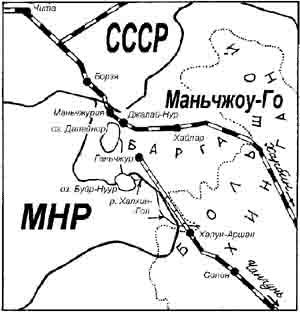
Река Халхин-Гол расположена на крайнем востоке Монголии, течет по ее территории с юга на север на протяжении 70—80 км примерно в 20 км от границы. Ширина реки — 40—130 м, глубина на отдельных участках до 2,5 м. Скорость течения — до 1 м/cек, питание преимущественно дождевое. Долина неширокая, 2—3 км. К западу от реки — плоская, песчаная равнина, покрытая ковылем и редким кустарником, к востоку же, до границы, — перемежающиеся песчаные холмы высотой до 50 м, ложбины и впадины глубиной 30—40 м. Постоянных населенных пунктов нет. За границей Монголии начинается Барга — территория в Маньчжурии: степная равнина, ограниченная на востоке и юго-востоке Большим Хинганом. На северо-востоке Барги — оз. Далайнор и граница с СССР, станция Маньчжурия бывшей Китайской Восточной Железной Дороги (КВЖД).


События 1939 года

В 1939 г. Германия после раздела и оккупации Чехословакии стала сильнейшей военной державой Европы. Великобритания и Франция уже заключили с ней договоры о ненападении. Германию поощряли создавать тысячелетний рейх за счет жизненного пространства на востоке.
В 1939 г. Япония стала сильнейшей военной державой Азии. Она уже оккупировала Корею, Маньчжурию (создав там марионеточное государство Маньчжоу-Го), вела активные военные действия в Китае.
Наметилась перспектива повторения интервенции 1918 г. против СССР, только поэтапной. Но пока задача состояла в том, чтобы выжидать. Поэтому в Москве летом 1939 г. представители Великобритании и Франции, не имевшие полномочий что-либо подписывать, вели переговоры с СССР о создании союза против Германии.
А на востоке уже произошли события у оз. Хасан, маловразумительно разъясняемые сейчас. Здесь единственное место, где можно было построить морской порт для выхода Маньчжоу-Го к Японскому морю. Дело за малым — взять под контроль советскую территорию в районе оз. Хасан и строить порт на реке Туманной (Туманган, Тумыньцзян). В боях в районе Хасана в 1938 г. японцы потерпели поражение.
Интерес японцев к Халхин-Голу также определялся необходимостью решения транспортных задач с помощью новых коммуникаций.


Почему Халхин-Гол?

Японская интервенция 1918 г. осуществлялась по линии КВЖД на Читу (чтобы перерезать Транссибирскую магистраль) с дополнительными фланговыми ударами на Благовещенск и Хабаровск; новое японское вторжение должно было направиться по этим же проторенным путям. С отдельными поправками, конечно.
Такими поправками были уроки интервенции и уже осуществленное к 1939 г. господство Японии в Маньчжурии и прилегающей части Китая. Для массированного вторжения в СССР пропускной способности КВЖД было недостаточно, да и положение дел на ней для советской разведки не было секретом. Вот если бы к ней в пару железную дорогу из глубины Китая! Поэтому еще в 1937 г. японцы приступили к строительству железной дороги от г. Солон на г. Халун-Аршан и далее, в середину Барги, в г. Ганьчжур. Эта дорога шла бы параллельно КВЖД на расстоянии 125 км от нее. Далее от Ганьчжура варианты: грунтовые автодороги или продолжение железной дороги уже до станции КВЖД Джалай-Нур.
Новая дорога проектировалась в обход отрогов Большого Хингана вдоль маньчжуро-монгольской границы. При этом «коридор» между горами и границей имел на некоторых участках ширину всего 2—3 км. Проектируемая дорога становилась доступной не только наблюдению, но и прицельному артиллерийскому огню с позиций, скрытых в холмах на монгольской территории. Эффективность такой дороги в военное время сводилась к нулю. А для вторжения в СССР дорога должна была действовать бесперебойно. Выход в Токио был найден — упорядочить границу Маньчжоу-Го и Монголии, отодвинуть ее на запад до естественного географического препятствия — р. Халхин-Гол.


Конфликт

Конфликт начался не решительными боевыми действиями и даже не пограничными провокациями, а историей с географией. Был издан приказ об уничтожении японских изданий справочного характера, где «неправильно» была показана восточная граница Монголии. Одновременно с этим японские картографы приступили к изготовлению «правильных» карт, на которых граница Монголии была показана как раз по р. Халхин-Гол. Такого рода операция давала возможность Японии именовать грядущие события на Халхин-Голе пограничным инцидентом между Маньчжоу-Го и Монголией.
Лишь когда было подготовлено это «информационное обеспечение», начались провокации на границе. В них участвовали мелкие группы кавалеристов из армии Маньчжоу-Го и японские солдаты.
СССР был связан с Монголией договором о взаимопомощи, а в Москве хорошо помнили, что такое японская интервенция, поэтому советские войска сразу пришли на помощь

Ситуация возле границ СССР, Монголии и Маньчжоу-Го в 1939 г.
Железная дорога Халун-Аршан—Ганьчжур, проектируемая Японией дополнительно к КВЖД для дальнейшего наступательного движения на СССР, зажата между отрогами Большого Хингана и монгольской границей

монгольским. К концу июня 1939 г. в районе Халхин-Гола соотношение японско-маньчжурских и советско-монгольских войск было 38 тыс. чел. к 12,5 тыс., а к 10 августа — 75 тыс. чел. к 57 тыс. Шли тяжелые бои.
Мир заинтересованно следил за событиями: на востоке СССР втягивался в конфликт с Японией, на западе вот-вот втянется в конфликт с Германией.
20 августа 1939 г. советско-монгольские войска начали большое наступление и к вечеру 23 августа окружили основные силы противника. 23 августа в Москву прилетел министр иностранных дел Германии И. Риббентроп и подписал пакт о ненападении между СССР и Германией. 28 августа японское правительство подало в отставку. 1 сентября Германия начала войну с Польшей. 3 сентября Великобритания и Франция объявили войну Германии. 16 сентября по просьбе Японии на Халхин-Голе было заключено перемирие. В этот же день польское правительство бежало в Румынию. 17 сентября СССР начал поход в Западную Белоруссию и Западную Украину — территории, отторгнутые панской Польшей от Советской России в 1920 г. Начал, имея пакт с Германией и не опасаясь быть втянутым в военный конфликт с ней.
Блицкриг в Польше продолжался месяц, о нем хорошо известно, а о четырехмесячных событиях на Халхин-Голе известно меньше. Но вот потери (убитые и раненые) свидетельствуют об ожесточенности боев: на Халхин-Голе СССР потерял 18,5 тыс. чел., Япония — около 61 тыс.; в Польше: Германия потеряла 45 тыс. чел., Польша — 200 тыс.
Как видим, потери сопоставимы.

Следствия

В 1939 г. СССР не удалось втянуть в мировую войну, втянулись в нее другие. Великобритания и Франция из сторонних наблюдателей на московских переговорах превращались, пусть в потенциальных, но все же союзников СССР.

Мрачная перспектива для Японии в случае войны с СССР стала очевидной: советские войска воевали лучше и обладали лучшей военной техникой, планы строительства железной дороги на Ганьчжур рухнули. Но это на суше. А на море? Под влиянием событий на Халхин-Голе Япония развернула свои устремления с севера на юг — на Филиппины, в Малайзию, Индонезию. Японская промышленность стала производить не танки, а авианосцы, не полевые, а корабельные орудия... В Тихом океане Япония не могла не столкнуться с США. Это значило, что на востоке СССР становилось спокойнее (в апреле 1941 г. Япония и СССР заключили договор о нейтралитете), а в мире у нашей страны появился еще один потенциальный союзник — США, хотя и далеко не сразу. Когда 22 июня 1941 г. Германия напала на СССР, сенатор Г. Трумэн заявил о том, что если будет побеждать Германия, то Америка поможет России, если будет побеждать Россия, то Германии, и пусть эти страны как можно больше убивают друг друга. 7 декабря 1941 г., когда японцы разбомбили Пёрл-Харбор — военно-морскую базу США на Тихом океане, эти слова даже потеряли свой человеконенавистнический смысл — уже США стали искать союза с СССР против Японии.

* * *

И еще об одном историко-географическом законе унаследованного развития. Во время войны с Японией (9 августа—2 сентября 1945 г.) Советский Союз со своей территории главные удары наносил по тем же, унаследованным от времен японской интервенции направлениям, только в обратную сторону: вдоль КВЖД
(от Читы и Владивостока), от Благовещенска и Хабаровска на КВЖД (соответственно на Цицикар и Харбин).


А сейчас тружусь в Монголии, до октября делаем съемку 25000, с поисками хромитов. Наранский офиолитовый массив - это Монгольский Алтай, граница с пустыней Гоби. База - юрточный городок на высоте 2500, работаем выше, до 3000м. В конце мая выпадал снег, на днях прошли грозы и сегодня всё заволокло туманом, камералим, топим печки. ...


Tuesday, August 7, 2012

Growing pains for Mongolian agriculture


Growing pains for Mongolian agriculture

In mid-June T. Badamjunai, the minister of food, agriculture and light industry, told the cabinet that the livestock industry expects 15m births this year, a record high, and that the spring planting of most crops was almost complete.
Animal herding provides almost two-thirds of agricultural production, while the main crops grown are wheat, potatoes and vegetables. These saw rises in output of 25% (433,400 tonnes), 14% (191,500) and 18% (97,200), respectively in 2011 thanks in part to a crop rehabilitation programme (CRP) that ran between 2008 and 2010.
The introduction of measures such as 40-50% loans for fuel, wheat seeds and fertilisers, along with Customs remittances and tax incentives for small and medium-sized enterprises (SMEs) are hoped to produce even higher yields in 2012, with targets of 490,000 tonnes of wheat, 200,000 tonnes of potatoes and 110,000 tonnes of other vegetables from 330,000 ha of arable land. The ministry has also procured new technical equipment using state funds and soft loans from China.
Trade links with Beijing are emerging as an area of great potential for agriculture, with Prime Minister S. Batbold predicting in May it could one day emulate the mining sector’s level of exports to China. Batbold made the claim as he was announcing that talks were under way for a deal that would see 100,000 tonnes of crops exported to China annually.
In a similar agreement, in 2011 Ulaanbaatar agreed to export 8m sheep. However, as a result of concerns over depleting reserves, inflation and speculation in March the government restricted meat exports until July 1. Such moves highlight recurring national concerns over the need to build up reserves for dzuds (harsh winters), which in 2009-10 claimed up to 17% of livestock – 7.8m animals.
Other concerns over such livestock exports include a fear that over-dependence on animal husbandry for meat and the nation’s cashmere industry are both contributing towards desertification. The process has seen a 20-30% decrease in pasture grassland yields over the past 40 years due to an increase in air temperature, increased dust storms and over-grazing.
The problem has likely worsened due to the move to a market economy in the early 1990s. As the privatisation of agriculture has led to production being dominated by household-level production, the sector is hard to regulate and less attractive to investors.
The CRP focused on establishing legally and economically favourable conditions for farming and vocational programmes, while bringing more advanced technologies and techniques into the sector, but critics say it didn’t represent a thorough enough attempt to establish farms on a truly commercial basis.
In a step expected to lay the groundwork for better coordination and regulation, the country launched its first nationwide agricultural census in May, meant to cover all households, entities and organisations. It will also provide data on land use, ownership, soil erosion, afforestation, protection, utilisation and irrigation. This follows a law passed in June 2011 establishing a state-run commodities exchange to help determine fair market pricing and encourage farmers to form independent cooperatives.
One possible model for future farming investment that uses foreign expertise while promoting sustainable techniques was a May 2011 investment by the Korea Mongolia Agricultural Development Preparation Committee, which leased 30,000 ha in the Khalkhgol region to carry out eco-friendly agriculture and livestock breeding. Both the Korean and Mongolian governments said the “Special Economic Agricultural Zone” would contribute to Mongolia’s food export market while helping to ease Seoul’s food-security fears.
Addressing the concerns over the lack of foreign interest in the sector, officials told OBG the government was working to improve the investment climate for agriculture. “There is a substantial possibility to increase investments in our sector. We will work towards proper management of investment policies to increase economic efficiency,” Badamjunai told OBG. “Given our agricultural potential and raw material resources, attracting investment for developing export-orientated industries is significant.”
Agro-processing, such as the processing of meat, milk, leather and raw materials, is one area identified as ripe for growth. However, agro-processing industries are generally on a small scale domestically, with only cashmere and some niche products currently available for export.
Technological innovations have lifted yields to new levels and the next step will be to create viable agriculture industries that invite foreign investment. With no shortage of arable land – if grazing is well managed – and a host of other high-quality raw materials at its disposal, Mongolia’s agriculture industry should post improved performance. However, until the sector is better organised and regulated, it will be hard for it to attract the investment it needs.

Mongolia: Focus on investment in tourism


Mongolia: Focus on investment in tourism


With the 2015 target date by which Mongolia hopes to welcome 1m visitors per year drawing nearer, officials are calling on the government to channel investment into the country’s tourism industry and take specific steps to encourage greater private sector participation.
Mongolia’s wealth of attractions, such as its fossil fields in the Gobi Desert and the diversity of its unspoiled landscapes, should provide solid foundations to develop the tourism sector and tap niche markets.
But officials have voiced concerns that underinvestment in the industry and a lack of action aimed at driving growth are restricting its potential, with some critics questioning whether tourism risks being eclipsed by the country’s dominant mining sector.
Figures show that the number of people coming to Mongolia is on the rise, with visitor numbers up 11% in the past three years and revenues showing an increase of 32.5% for the same period. However, with tourism still only contributing around 5% to GDP, industry officials are calling for tangible measures to be put in place aimed at generating sectoral growth. In particular, they highlight the need for investment in transport infrastructure, internet and communications connections, high-quality hotel accommodation, flight links and human resources.
“Investment is needed to create a productive tourism sector,” Ts. Orgodol, the head of tourism at the Ministry of Nature, Environment and Tourism, told the Mongolian Economy magazine in June. “Instead of just talking we must start taking action. The government must create a favourable environment for the private sector to operate.”
Orgodol said Mongolia lacked platforms, such as research centres and museums, which would enable the country to share its rich history with visitors. “Today we are not able to tell those great historical stories and display them through exhibits,” he said.
With expansion in Mongolia’s tourism industry slower than industry officials would like, Orgodol, along with others, also fears that the sector is missing out on opportunities to attract good quality human resources, such as translators, guides, managers and accountants, who are instead opting to take up employment in mining.
Some officials, such as B. Indraa, the director of the Mongolian National Tourism Organisation, have additional worries that mining could threaten elements of the country’s heritage. In June, Indraa voiced her concerns on hearing that mining companies had acquired land-use rights in places of historic interest, including the Bichigt Khad Valley, the Darkhad Valley and the sacred meditation sites of Danzanravjaa.
“It’s sad to see the landscape and culture in many areas of Mongolia are irreversibly changing because of mining. There’s no escaping the fact,” she told the Inter Press Service.


While there is frustration among those who believe mining has contributed to delays in the government’s efforts to drive up visitor numbers, some tourism officials acknowledge that the lucrative extractive industries can also play a key role in providing the funds for much-needed infrastructure development.
N. Erdenebat, the vice president of the Mongolian Tourism Association, pointed out that other resource-rich countries had successfully adopted this strategy. “We can reach the level of countries such as Canada, Australia, Chile, Malaysia, and Arabic countries, which all invested their resource profits into their tourism industries,” he said.
Mongolia has already taken the first step along this path by using mining revenues to partially finance the country’s forthcoming Khushigiin Khundii International Airport, which is expected to be a key component in driving tourism growth and improving domestic links.
The mining industry is also proving to be a key driver in Ulaanbaatar’s development, leading to an influx of expatriate workers, investment in public transport, and a wave of major retail brand shop openings. The Hong Kong-based Shangri-La Group, along with MCS Holding, Mongolia, plans to open a 273-room hotel in the capital city by 2013 on the back of the city’s expansion, while Hyatt Regency Ulaanbaatar is to build a 259-room facility which is scheduled for completion the following year.
While concerns remain about the pace at which Mongolia’s tourism sector is expanding, most industry players acknowledge that pushing for resource revenues to be channelled into the industry rather than targeting mining is the way forward. Certainly, Mongolia’s rich resources could be key in the country’s efforts to fund the new infrastructure and marketing initiatives that its tourism industry needs to drive growth.


Focus on investment in tourism

2015 он гэхэд Монгол улс жилд 1 сая жуулчид хүлээн авдаг болсон байх зорилтот өдөр ойртох тусам тус улсын аялал жуулчлалын салбарт хөрөнгө оруулалтын суваг гаргаж, хувийн хэвшлийнхний илүү өргөн оролцоог дэмжих бодитой алхам хийхийг албаны хүмүүс засгийн газарт хандан уриалж байна.
Говь цөлийн нутгийн чулуужсан малтмалууд болон өвөрмөц шинж төрх бүхий хөндөгдөөгүй газар нутаг зэрэг бусдыг татах Монголын баялаг нь тус улс аялал жуулчлалын салбараа хөгжүүлж, тодорхой бүтээгдэхүүнд чиглэсэн дэд зах зээлийг ашиглаж эхлэх бат бөх суурь нь болж өгнө.

Гэвч албаны хүмүүс тус салбар дахь хангалтгүй хөрөнгө оруулалт мөн хөтлөн дагуулах өсөлтөд чиглэсэн бодитой алхам хийгдээгүй байгаа байдал нь түүний өсөлтөд хязгаарлалт болж байгаад санаа зовинож, зарим нь тус улсад давамгайлах болсон уул уурхайн салбараас болж аялал жуулчлалд эрсдэл учирч, өнгө зүсээ алдаж байна хэмээн шүүмжилсэн.
Монголд ирж байгаа хүмүүсийн тоо өсч, өнгөрсөн гурван жилд зорчигчдын тоо 11%-иар өсч, мөн хугацаанд орлого 32.5%-иар нэмэгдсэн талаар тоо мэдээллээс харж болно. Гэвч аялал жуулчлалын салбар нь ДНБ-ий ойролцоогоор дөнгөж 5%-ийг бүрдүүлж байгаа үед, албаны хүмүүс салбарын өсөлтийг буй болгоход чиглэсэн дорвитой арга хэмжээ авахыг уриалж байна. Ялангуяа тэд тээврийн дэд бүтэц, интернет болон холбоо харилцааны холболтууд, өндөр түвшний зочид буудлын байр, нислэгийн холболт болон хүний нөөцөд хөрөнгө оруулах шаардлагатай байгаа талаар тодорхой ярьж байна.
“Үр бүтээлтэй аялал жуулчлалын салбарыг буй болгохын тулд хөрөнгө оруулалт хэрэгтэй” хэмээн 6-р сард Байгаль орчин, аялал жуулчлалын яамны аялал жуулчлалын газрын дарга Ц.Оргодол Монголын Эдийн засгийн сэтгүүлд хэлжээ. “Зүгээр л ярихын оронд бид үйлдэл хийх ёстой. Засгийн газар хувийн хэвшлийнхэнд үйл ажиллагаа явуулах таатай орчинг буй болгох ёстой.”
Монгол улс өөрийн баялаг түүхээ жуулчидтай хуваалцах боломж олгох судалгаа шинжилгээний төвүүд, музей зэрэг үндсэн суурь бааз муутай байна хэмээн Оргодол хэлэв. Тэрээр “Өнөөдөр бид тэдгээр агуу их түүхийг ярьж, тэдгээрийг үзэсгэлэнгээр дамжуулан дэлгэн харуулах боломж алга,” хэмээн хэлсэн байна.
Монгол улсын аялал жуулчлалын салбар тус салбарын албаны хүмүүсийн хүссэнээс удаан боловч өргөжихийн хирээр Оргодол зэрэг бусад нөхдүүд орчуулагч, хөтөч, менежер, нягтлан бодох зэрэг сайн бөгөөд чанартай хүний нөөцүүд уул уурхайн салбарт ажил эрхлэхийг илүүд үзэх болсон тул тус салбар тэднийг татах боломжоо алдаж байна хэмээн айж байгаа ажээ.
Монголын Үндэсний аялал жуулчлалын байгууллагын захирал Б.Индраа зэрэг зарим албаны хүмүүс уул уурхайн салбар нь тус улсын өв соёлын бүрдэл хэсгүүдэд аюул учруулж болзошгүй гэсэн нэмэлт айдастай байгаа ажээ. 6-р сард болсон сонсголын үеээр Бичигтийн хадны хөндий, Дархадын хотгор, Данзанравжаагийн ариун бясалгалын орон зэрэг түүхэн ашиг сонирхол бүхий газруудад уул уурхайн компаниуд газар ашиглах эрх авсан байгаа талаар санаа зовинож байгаагаа Индраа мэдэгдсэн байна.
Тэрээр Интер Пресс үйлчилгээний байгууллагад “Уул уурхайгаас болж Монгол орны олон газар нутгийн газрын төрх байдал болон соёл урлаг эргэлт буцалтгүйгээр өөрчлөгдөж байгааг харахад харамсмаар байна. Уг бодит үнэнээс зайлах аргагүй.” гэжээ.

Жуулчдын тоог өсгөх засгийн газрын хүчин чармайлтыг хойшлуулахад уул уурхай нөлөөлсөн гэж үздэг нөхдүүд цухалдаж байх хооронд, аялал жуулчлалын зарим албаны хүмүүсийн үзэж байгаагаар бол маш хэрэгцээтэй байгаа дэд бүтцийн хөгжлийн санхүүжилтийг хангахад олборлох үйлдвэрлэлийн ашигтай салбарууд чухал үүрэг гүйцэтгэж чадах ажээ.
Монголын жуулчдын холбооны Дэд ерөнхийлөгч Н.Эрдэнэбат байгалийн баялаг ихтэй бусад улс орнууд энэ стратегийг амжилттай хэрэгжүүлсэн талаар цохон тэмдэглэсэн байна. Тэрээр “Байгалийн нөөцөөсөө олсон ашгаа аялал жуулчлалынхаа салбарт хөрөнгө оруулсан Канад, Австрали, Чиль, Малайз, Арабын зэрэг бүх орнуудын түвшинд бид хүрч чадна.” хэмээн тэр хэлсэн байна.
Аялал жуулчлалын өсөлтийг дагуулж, орон нутгийн [нислэгийн] холболтуудыг сайжруулах гол бүрэлдэхүүн хэсэг болж буй тус улсад удахгүй байгуулагдах Хөшигтийн хөндийн Олон улсын нисэх онгоцны буудлыг хэсэгчилэн санхүүжүүлэхэд уул уурхайгаас олсон орлогоо ашиглах замаар Монгол улс энэ замыг дагасан анхны алхмаа хэдүйнээ хийсэн байна.
Уул уурхайн салбар нь гадны ажилчдын урсгал, нийтийн тээврийн хөрөнгө оруулалт, жижиглэн худалдааны голлох брэнд дэлгүүрийн нээлтүүд ар араасаа давалгаалахад хүргэсэн Улаанбаатарын хөгжлийн гол хөдөлгөгч хүч болохыг мөн баталж байна. ЭмСиЭс Холдинг Монголтой зэрэгцээд Хонг Конг-д байрлалтай Шангри-Ла Груп нь (Shangri-La Group) хотын өргөжилтийн ард талд 2013 он гэхэд нийслэл хотод 273 өрөөтөй зочид буудал нээж, харин Хиат Рижэнси Улаанбаатар нь (Hyatt Regency) дараагийн жилд нь 259 ортой байгууламжийг барьж дуусгахаар төлөвлөж байна.
Монголын аялал жуулчлалын салбарын өргөжиж буй хурдтай холбоотой санаа зовнисон асуудал байхын зэрэгцээ тус салбарын ихэнх тоглогчид уул уурхайг урагшлах арга зам хэмээн төвлөрөхийн оронд байгалийн баялгаас олсон орлогыг тус салбар луу чиглүүлэн татах үйл явцыг хурдасгах нь зөв хэмээн хүлээн зөвшөөрч байна. Өсөлтийг дагуулахын тулд тус улсын аялал жуулчлалын салбарт хэрэгтэй шинэ дэд бүтэц болон маргетингийн санаачлагуудыг санхүүжүүлэх манай улсын хүчин чармайлтын хувьд Монголын байгалийн баялаг нөөц нь үнэхээр гол түлхүүр байж болох юм.